Walk into any garden center and you’ll find a wall of bagged compost, each one promising to be exactly what your lawn needs. Some are labeled for vegetable gardens, some for flower beds, and only a few actually say anything about turfgrass at all. Figuring out the best compost for lawn soil improvement isn’t always as simple as grabbing the bag with the greenest label. The right choice depends on your soil type, your goals, and how you plan to apply it.
This comprehensive buyer’s guide explains everything you need to know about choosing the best compost for lawn soil improvement. You’ll learn about the different types of compost, how to judge quality, when and how much to apply, and the mistakes that trip up even well-intentioned homeowners.
Why Compost Matters
Most conversations about lawn care focus on what’s happening above the soil mowing height, watering schedules, fertilizer timing. Compost works on the part of the lawn that’s easy to forget about: the soil itself, which is ultimately what determines how well grass can access water, nutrients, and oxygen in the first place.
Compost is decomposed organic matter, and adding it to a lawn improves soil in ways that synthetic fertilizer alone can’t replicate. It introduces beneficial microbes and fungi that help break down thatch, cycle nutrients, and support root health. It improves soil structure, helping heavy clay soils develop better texture and helping sandy soils retain more water and nutrients instead of letting them drain straight through. And it adds a slow, steady supply of organic nutrients that feed the soil biology over time, rather than delivering a quick spike the way many synthetic fertilizers do.
The result, especially over multiple seasons of consistent use, is a lawn that needs less water, resists disease more effectively, and develops a deeper, more resilient root system. Compost isn’t a quick fix the way a fertilizer application can feel like its benefits build gradually, which is exactly why the soil underneath a well-composted lawn tends to look and feel noticeably different after a year or two compared to a lawn that’s only ever received synthetic inputs.
Types of Compost
Not all compost is created equal, and the source material has a big effect on what it actually does for a lawn. Here’s a breakdown of the most common types available.
Yard Waste Compost
Yard waste compost is produced primarily from leaves, grass clippings, shrubs, and other plant materials collected through municipal or commercial composting programs.
It is one of the most commonly available composts and works well for general lawn improvement.
Advantages
- Affordable.
- Widely available.
- Rich in organic matter.
- Excellent for improving soil structure.
Considerations
Quality varies between suppliers, so always choose screened, fully composted products.
Mushroom Compost
Mushroom compost is the growing medium left behind after commercial mushroom production, made from a mix of organic materials like straw, hay, and manure that have already been used to grow a mushroom crop.
Advantages
- Rich in nutrients.
- Improves soil texture.
- Increases water-holding capacity.
- Excellent for clay soils.
Considerations
Some mushroom compost contains relatively high salt levels, avoid excessive applications on newly established lawns or salt-sensitive grass varieties.
Manure-Based Compost
Composted animal manure, usually from cattle, horses, or poultry, provides a strong nutrient boost, particularly nitrogen.
Advantages
- High nutrient content.
- Excellent organic matter.
- Encourages microbial activity.
- Improves long-term fertility.
Considerations
Only use fully composted manure, fresh manure may contain harmful pathogens, weed seeds, and excessive ammonia that can damage grass
Biosolids Based Compost
Made from treated municipal wastewater solids that have gone through an extensive composting and sanitization process. These products are regulated and tested for safety, and they tend to be nutrient-rich and relatively inexpensive, though some homeowners prefer to avoid them for personal or environmental reasons.
Considerations
Some homeowners prefer alternative compost sources for environmental or personal reasons.
Worm Castings (Vermicompost)
Produced by earthworms digesting organic material, worm castings are a concentrated, nutrient-dense compost that’s gentle enough to use in larger quantities without risk of burning the lawn. It’s typically more expensive per volume than other compost types, making it more common as a supplement or starter treatment than a primary topdressing material for large lawns.
Considerations
Worm castings are relatively expensive, making them more practical for smaller lawns or as an additive to other compost blends.
Compost Blends
Many bagged products on the market are actually blends — combining a compost base with additional amendments like peat moss, biochar, or sand, designed for specific goals such as improving drainage or adding water retention. These can be a good option when a specific soil issue is the priority, rather than general soil improvement.
Considerations
Always read the product label to ensure the blend matches your lawn’s needs.
Homemade vs. Store-Bought Compost
One of the most common questions homeowners face is whether to compost at home or simply buy a bagged or bulk product. Both approaches can produce excellent results, but they come with different tradeoffs.
Homemade Compost
Homemade compost is produced from kitchen scraps, leaves, grass clippings, and other organic waste generated around your property.
It gives full control over what goes into it, which appeals to homeowners who want to avoid synthetic inputs, herbicide residue, or specific additives found in some commercial products. The tradeoff is time and volume home composting typically takes several months to a year to fully break down, and most home setups don’t produce nearly enough finished compost to topdress an entire lawn in one application. It works well as a supplement, or for smaller lawns and garden beds, but often isn’t practical as the sole compost source for a larger property.
Store-Bought Compost
whether purchased in bags from a garden center or in bulk from a local supplier, solves the volume problem immediately. It’s available in the quantities needed for full lawn topdressing, and quality products are tested for contaminants, pH, and nutrient content, giving more predictability than a homemade batch. The tradeoff is cost, which scales with lawn size, and some variability in quality between brands and suppliers, particularly with less reputable bagged products that may not be fully finished or may contain unwanted debris.
For most homeowners with a lawn of any significant size, a practical approach combines both: using homemade compost for garden beds or as a supplemental treatment, and buying compost often in bulk from a local landscape supply yard, which tends to be far more cost-effective per square foot than bagged compost from a retail store for the larger-scale topdressing a full lawn requires.
How to Choose High-Quality Compost
Compost quality varies enormously between products, and a poor-quality batch can do more harm than good.
Fortunately, several simple checks can help you identify quality compost.
Check the Smell
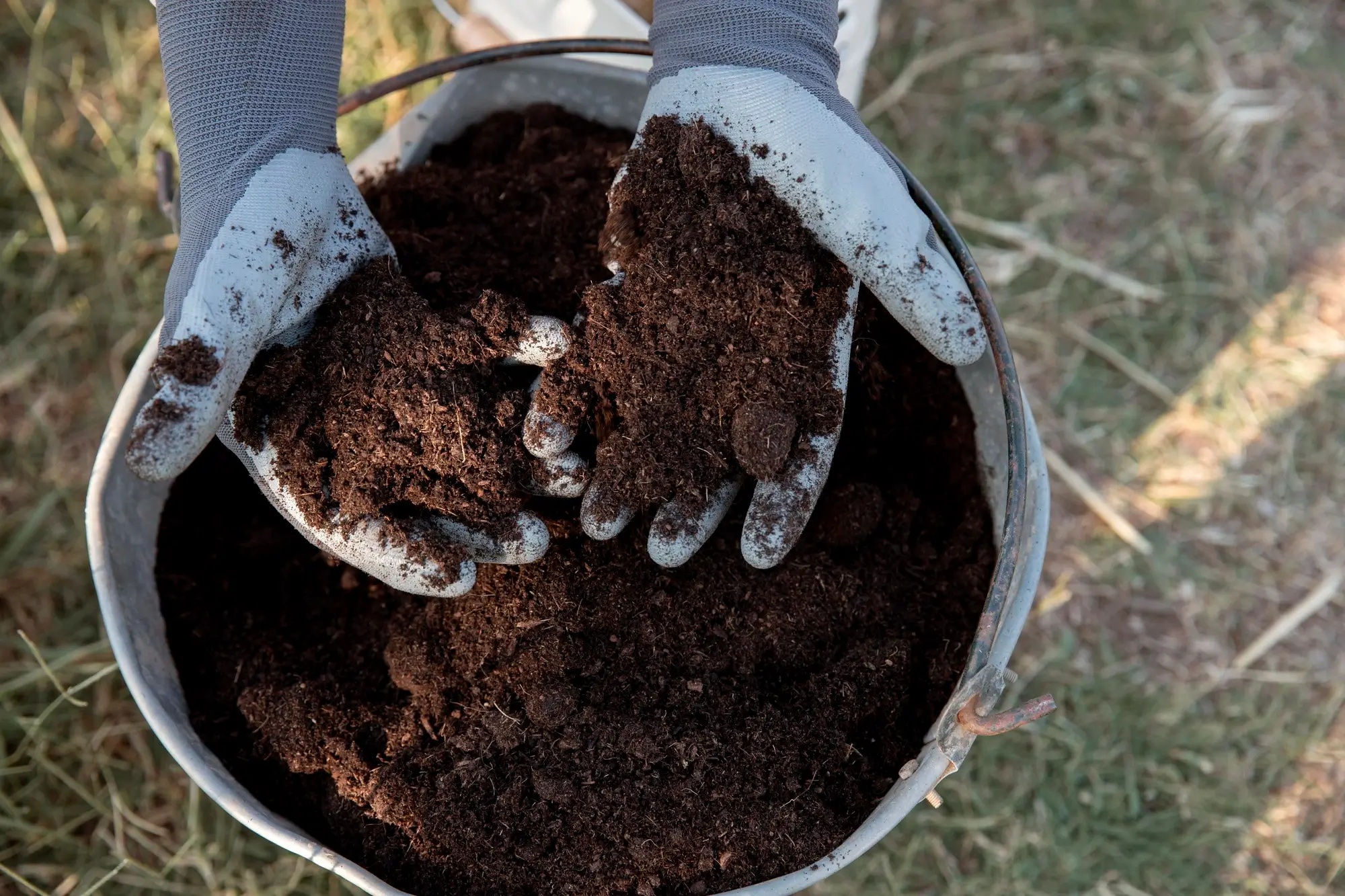
Finished, high-quality compost has an earthy, pleasant smell, similar to healthy forest soil. A sour, ammonia-like, or rotten smell indicates the compost wasn’t fully finished, which can actually harm grass rather than help it.
Examine the Color
Quality compost is typically a dark brown to black color throughout. Lighter, inconsistent coloring can indicate an incomplete or uneven composting process.
Feel the Texture
Good compost should be crumbly and uniform, without large recognizable chunks of the original material (like whole leaves, wood chips, or manure). Visible undecomposed material means the compost hasn’t fully broken down and may continue decomposing after application, temporarily tying up nitrogen that the grass needs.
Check Moisture Content
Good compost should feel moist but not soggy or dripping wet. Compost that’s too wet is harder to spread evenly and may indicate poor aeration during the composting process.
Screening
Look for compost that’s been screened to remove large debris, rocks, and contaminants. Coarser, unscreened compost can work fine for garden beds but is more difficult to spread evenly across a lawn.
Source Transparency
Reputable suppliers should be able to explain:
- What materials were composted.
- How long the compost matured.
- Whether contaminants were removed.
- Whether laboratory testing has been performed.
A supplier who can’t or won’t answer basic questions about sourcing is a mild red flag.
Testing and Certification
Where available, products certified by an independent testing program (such as the Seal of Testing Assurance program used in some compost quality certifications) offer some assurance around nutrient content, pH, and contaminant levels. This matters most for bulk or commercial-scale purchases, where consistency across large volumes is harder to verify by eye alone.
Consider Soil pH
Most compost falls in a mildly acidic to neutral range, which suits the majority of turfgrass species, but it’s worth checking if you’re applying large quantities regularly, particularly if your existing soil pH is already outside the ideal range for your grass type.
A quick smell, texture, and color check before buying or asking to see a handful of a bulk product before it’s delivered catches most quality issues before they become a lawn problem.
When to Apply Compost
Timing affects how much benefit a compost application actually delivers, since the goal is for it to work into the soil and support active root growth rather than simply sitting on the surface.
1. Alongside Aeration
The single most effective timing for compost application is right after core aeration. The holes created by aeration give compost a direct path into the soil profile, rather than sitting entirely on the surface where its benefits are more limited. This combination is often referred to as topdressing, and it’s the standard recommendation for improving compacted or poor-quality soil over time.
2. During the Growing Season
Always apply compost when your lawn is actively growing.
Cool-season grasses (Kentucky Bluegrass, Ryegrass, Fine Fescue)
- Early autumn (best)
- Early spring
Warm-season grasses (Bermuda, Zoysia, St. Augustine)
- Late spring
- Early summer
Applying compost during these periods helps the lawn recover quickly while promoting healthy root growth.
3. Before Overseeding
If you’re planning to overseed your lawn, spread compost immediately beforehand.
Compost:
- Improves seed-to-soil contact
- Retains moisture around seeds
- Provides nutrients for young seedlings
- Encourages faster germination
When combined with overseeding, compost significantly improves the chances of establishing thick, healthy turf.
4. Avoid Dormant Seasons
Avoid applying compost during:
- Frozen winter conditions
- Extreme summer heat
- Drought periods
Grass isn’t actively growing during dormancy, meaning the compost provides little immediate benefit and may simply remain on the surface until growth resumes.
5. Apply Thin Layers Regularly
Instead of one heavy application, use lighter applications once or twice a year.
Regular topdressing gradually improves:
- Soil fertility
- Organic matter
- Root health
- Overall lawn resilience
This approach delivers better long-term results while reducing the risk of smothering the grass.
How Much Compost Should You Use?
Applying the correct amount of compost is just as important as choosing the right type. Too little won’t noticeably improve the soil, while too much can bury the grass and create uneven surfaces.
For a standard topdressing application on an established lawn, a layer of about a quarter to half an inch of compost spread evenly across the surface is the generally recommended amount. This works out to roughly 1 to 2 cubic yards of compost per 1,000 square feet of lawn, though exact coverage depends on the compost’s density and moisture content.
For a lawn with significant soil problems, such as heavy compaction or very poor native soil, applying on the higher end of that range (closer to half an inch) and repeating the application annually for two to three years tends to produce noticeably better results than trying to fix the problem with a single heavy application.
When overseeding or establishing a new lawn, a slightly deeper application, often around half an inch to an inch worked into the top few inches of soil before seeding, helps give new grass the best possible start.
It’s worth noting that more isn’t always better. Piling compost too thick in a single application can bury and smother existing grass blades, particularly if the compost isn’t worked in or watered thoroughly afterward. Spreading a thin, even layer and allowing it to settle into aeration holes or existing thatch is far more effective than a single heavy dump in one spot.
Mistakes to Avoid
Even high-quality compost won’t produce good results if applied incorrectly. Avoid these common mistakes.
Using Unfinished Compost
Fresh or partially decomposed compost continues breaking down after application.
This process temporarily uses nitrogen from the soil, leaving less available for grass growth.
Finished compost should have:
- A dark brown or black color
- A crumbly texture
- An earthy smell
Avoid compost with strong ammonia or rotten odors.
Applying Too Thickly
A heavy layer of compost dumped onto the lawn without spreading it evenly can smother grass, block sunlight, and create an uneven surface that’s difficult to mow.
Skipping Aeration First
Applying compost to unaerated, compacted soil limits how effectively it can actually reach the root zone, since much of it stays on the surface rather than working its way down.
Ignoring Compost Source and Quality
Cheap, unscreened, or poorly composted products can introduce weed seeds, unpleasant odors, or uneven results. It’s worth spending a bit more for a reputable source, especially for a full-lawn application.
Applying at the Wrong Time of Year
Avoid applying compost when grass is dormant. The best results occur during active growth when roots can immediately benefit from improved soil conditions.
Forgetting to Water
Compost applied during dormancy provides little immediate benefit and can sometimes create a soggy, matted layer that sits on the surface until the grass resumes active growth.
Expecting Instant Results
Compost is a long-term soil improvement strategy, not an instant fix. Homeowners expecting dramatic changes within days are often disappointed, when in reality the real benefits build over multiple seasons of consistent application.
Conclusion
There’s no single “best” compost that works identically for every lawn, the right choice depends on your soil type, your goals, and what’s reasonably available in your area. What matters most is choosing a fully finished, good quality product, applying it at the right time and in the right amount (ideally alongside aeration), and being patient with the results. Compost isn’t a quick fix, but for homeowners willing to apply it consistently over a season or two, it remains one of the most effective and affordable ways to genuinely improve the soil a lawn depends on, rather than just treating the grass on top of it.
Frequently Asked Questions
How often should I apply compost to my lawn?
Most lawns benefit from compost topdressing once or twice each year. Applying compost after core aeration during the active growing season provides the greatest improvement in soil structure and root development.
Is bagged compost better than bulk compost?
Quality bagged compost can work just as well as bulk compost for smaller lawns, though bulk compost from a reputable local supplier is often more cost-effective for larger properties and allows for easier inspection of quality before purchase.
Can I use compost instead of lawn fertilizer?
Not entirely. Compost supplies slow-release nutrients and improves soil health, but lawns with nutrient deficiencies may still require fertilizer. Many homeowners combine compost with a balanced fertilizer for the best long-term results.
Will compost help with lawn drainage problems?
Yes, Compost improves soil structure, helping heavy clay soils develop the texture needed for water to move through more freely, though severe drainage issues may still require additional solutions like aeration, grading, or drainage systems.
Can too much compost hurt my lawn?
Yes. A layer applied too thickly can smother grass, and over-application over many seasons can occasionally push soil nutrient levels, particularly phosphorus, higher than ideal. Sticking to recommended application rates avoids this.
Can I spread compost without aerating first?
Yes, although aeration greatly increases the benefits. Compost applied after aeration reaches the root zone more quickly and improves soil structure more effectively.
Does compost help reduce lawn thatch?
Yes. Compost introduces beneficial microorganisms that naturally break down thatch over time, reducing excessive organic buildup.
How long does it take to see results?
Some improvements in lawn color and moisture retention may appear within a few weeks, but significant soil improvement usually develops over several months. The greatest benefits become noticeable after one or two years of regular applications.
How does compost application differ for cool-season versus warm-season lawns?
The core process is the same, but timing shifts to match each grass type’s active growth period. Cool-season lawns respond best to compost applied in early fall, with a secondary window in spring, while warm-season lawns benefit most from applications in late spring through early summer when they’re exiting dormancy and growing most vigorously.
Is homemade compost safe for lawns?
Yes, provided it is fully decomposed. Finished homemade compost should be dark, crumbly, and have an earthy smell. Avoid using compost that contains fresh food scraps, weeds with seeds, or partially decomposed materials.