A healthy, vibrant lawn adds beauty and functionality to any outdoor space. It provides a soft surface for children to play, pets to run, family gatherings, and everyday outdoor activities. However, even the healthiest turf has its limits. Constant foot traffic along the same routes whether from family members, visitors, children, pets, or even lawn equipment gradually wears down the grass and compacts the soil beneath it.
If you’ve noticed your lawn has bare patches along the route from the back door to the shed, or a worn strip where kids cut across to the swing set, you’re dealing with one of the most common lawn complaints homeowners face: foot traffic damage. The good news is that grass is remarkably resilient, and with the right combination of aeration, overseeding, and feeding, most trampled lawns can be brought back to full health within a single growing season.
This guide will walk you through why heavy foot traffic damages grass, how to identify the early warning signs, and the best step-by-step recovery plan you can follow and protect your lawn for years to come.
Why Foot Traffic Damages Grass
To understand how to repair a trampled lawn, it helps to understand what’s actually happening beneath your feet every time you walk across the grass.
The damage occurs in three major ways.
1. Soil Compaction
Every footstep presses down on the soil, squeezing the small pockets of air and space between soil particles. Healthy soil is roughly 50% solid material and 50% pore space, and that pore space is where roots breathe, water drains, and beneficial microbes live. Repeated pressure, especially along the same path day after day, gradually collapses that structure. The soil becomes dense and hard, almost like packed clay, even if it wasn’t clay to begin with.
Compacted soil creates several problems:
- Water struggles to penetrate to the surface: Instead of soaking in, water runs off or pools on the surface, meaning the grass roots underneath stay dry even after a good rain.
- Oxygen cannot reach the roots: Grass roots need to respire just like any other living tissue. Compacted soil suffocates them slowly.
- Grass Roots can’t expand properly: Even when a seed does germinate in compacted ground, the roots hit a wall of dense soil and can’t grow deep or wide enough to support healthy top growth.
- Drainage becomes poor, leading to puddles.
2. Physical Damage to Grass Plants
The crown of a grass plant, the point where the stem meets the root system, is especially vulnerable. It sits right at soil level, which is exactly where a shoe sole makes contact. Crush the crown enough times and the plant simply can’t recover, no matter how good the soil underneath is.
3. Weed Invasion
As healthy grass begins to disappear, weeds quickly move into the empty spaces.
Compacted soil favors weeds such as:
- Crabgrass
- Plantain
- Clover
- Goosegrass
These weeds tolerate poor soil conditions far better than most lawn grasses do, certain conditions make traffic damage worse. Walking on wet grass is far more damaging than walking on dry grass, because wet soil compacts more easily and wet blades tear rather than bend. Similarly, damage accumulates faster in shaded areas, since shade-stressed grass is already growing slower and has less reserve energy to recover between traffic events
Signs of Traffic Stress
Catching traffic damage early makes repair much easier, so it’s worth knowing what to look for at each stage.
Early Stage
During the early stages, the lawn still looks healthy from a distance but begins showing subtle warning signs.
You may notice:
- Grass appears thinner.
- Color becomes duller than surrounding areas.
- Footprints remain visible longer after walking.
- Grass springs back more slowly.
This is the easiest stage to fix, sometimes with nothing more than a change in walking pattern and a light feeding.
Middle Stage
As compaction progresses, the affected areas become much easier to identify.
Common symptoms include:
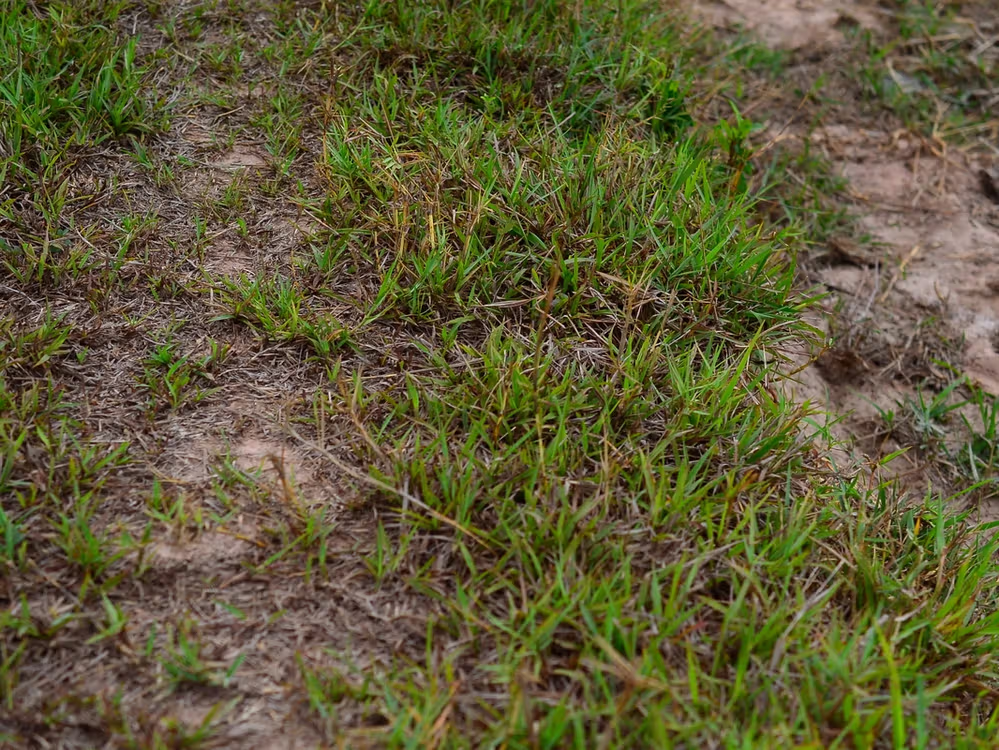
- Clearly visible walking paths
- Yellowing strip or pale green grass
- Sparse turf coverage
- Hard soil
- Slower recovery after mowing
- Water beginning to pool after rain
because the compacted soil is preventing water from actually reaching the roots., these areas often remain stressed even after irrigation.
Last Stage
If left untreated, heavy traffic eventually destroys the grass completely.
Symptoms are:
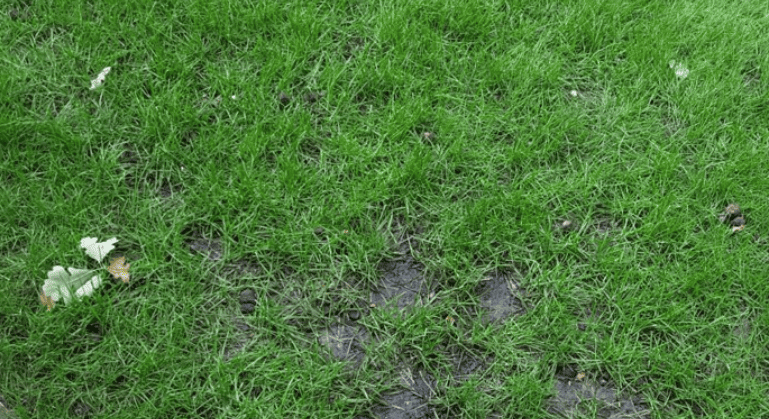
- Bare soil
- Deeply compacted ground
- Standing water after rainfall
- Weeds replacing grass
- Muddy pathways
At this point, the lawn requires more intensive repair rather than simple maintenance.
Secondary signs worth watching for:
- Weeds appearing in a linear pattern that follows a walking route
- Soil that feels noticeably harder underfoot than the rest of the lawn
- A screwdriver or garden fork that’s difficult to push into the ground more than an inch or two
- Grass that recovers more slowly after mowing in these areas compared to elsewhere
If you can push a standard garden fork into the soil with moderate effort to a depth of at least six inches, compaction likely isn’t severe. If it barely goes in at all, you’re dealing with significant compaction that will need mechanical aeration to fix.
Choosing the Right Recovery Method
There’s no single fix for traffic damage because compaction, bare soil, and thinning turf are really three separate problems that happen to show up together. A proper recovery plan addresses all three, generally in this order:
- Aeration to physically relieve soil compaction and restore pore space
- Overseeding to reintroduce grass where density has been lost
- Fertilizing to give new and existing grass the nutrients needed to establish and thicken up
Timing matters a great deal here. For cool-season grasses (like fescue, ryegrass, and bluegrass, common in northern climates), the best window for this work is early autumn, followed by early spring as a secondary option. Soil is still warm from summer, which helps new seed germinate quickly, while cooler air temperatures reduce stress on the plant. For warm-season grasses (like bermuda, zoysia, and St. Augustine, common in southern climates), late spring through early summer, once the grass is actively growing, is the better window.
Trying to overseed a warm-season lawn in autumn, or a cool-season lawn in the height of summer, is one of the most common reasons repair efforts fail. Match your timing to your grass type first, and the rest of the process becomes much more effective.
Step 1: Aeration
Aeration is the foundation of any real repair plan for traffic damage, because seeding and feeding a compacted lawn without first opening up the soil is a bit like trying to plant a garden in concrete. The seed and fertiliser simply can’t get where they need to go.
Core Aeration Vs Spike Aeration
There are two broad types of aeration equipment. Spike aerators simply push solid tines into the ground, which can actually make compaction worse over time by further compressing the soil around the spike. Core aerators, by contrast, physically remove small plugs of soil (typically 2–3 inches long and about half an inch wide) and deposit them on the surface. This genuinely relieves compaction because it removes material rather than just displacing it. For a lawn with real traffic damage, core aeration is the method worth using.
How to Aerate Properly:
- Water the lawn a day or two beforehand if the soil is dry; core aerators pull much cleaner plugs from moist soil than from bone-dry ground.
- Make at least two passes over heavily trafficked areas, ideally in perpendicular directions, so the holes are dense enough to make a real difference. A single light pass often isn’t enough where compaction is severe.
- Leave the soil plugs on the lawn surface to break down naturally; they contain beneficial microbes and will disintegrate within a couple of weeks, especially after mowing or rain.
- For small lawns, a manual core aerator or a rented walk-behind machine works well. For larger properties, a lawn care service with a tow-behind or self-propelled aerator will save considerable time and effort.
Aerating right before overseeding is ideal, since the holes left behind create perfect little pockets for seed to fall into, protected from birds and in direct contact with soil, which dramatically improves germination rates.
Step 2: Overseeding
Once the soil has been loosened through aeration, the next step is to replace the grass that has been lost. Overseeding fills in thin areas, thickens existing turf, and helps crowd out weeds before they become established.
A dense lawn is naturally more resistant to future foot traffic because healthy grass plants support one another and develop deeper, stronger root systems.
Choosing the Right Grass Seed
Selecting the proper grass seed is essential for long-lasting results. Whenever possible, choose a seed that matches your existing lawn and is specifically bred for heavy foot traffic. Many modern turf-type tall fescue and perennial ryegrass blends are marketed specifically as high-traffic or “sport” mixes, and they genuinely do hold up better under repeated wear than standard lawn seed. If you don’t know your existing grass type, a local garden centre or extension office can usually help identify it from a sample.
Seeding technique:
- Spread seed evenly across the aerated area using a broadcast or drop spreader, following the seeding rate on the product label. Applying too much seed causes overcrowding and weak seedlings; too little leaves the repair patchy.
- Lightly rake the seeded area so seed makes good contact with soil, rather than sitting exposed on top where it can dry out or blow away.
- A thin layer of straw mulch or a seed-starter mat can help retain moisture and protect seed from birds, particularly on exposed paths.
Watering New Seed
This is the step most people get wrong. New grass seed needs consistent light moisture, not deep infrequent watering, until it germinates. That typically means watering once or twice a day for five to ten minutes, keeping the top half-inch of soil consistently damp but not soaked, for the first two to three weeks. Once seedlings reach mowing height, gradually shift to deeper, less frequent watering to encourage roots to grow downward.
Keep People Off the area
This is non-negotiable, newly seeded patches need to be off-limits to foot traffic until the grass has been mowed at least two or three times, which usually takes four to six weeks depending on conditions. Consider temporary fencing, decorative stakes with string, or simply redirecting the usual walking path during this period. Skipping this step is the single most common reason overseeding efforts fail on high-traffic areas, since the whole point of the repair is undone the moment someone walks over tender new seedlings.
Step 3: Fertilising
Fertiliser supplies the nutrients needed for both recovering grass and newly germinated seedlings but timing and formulation matter.
At seeding time, use a starter fertiliser, which is formulated with higher phosphorus content specifically to encourage strong root development in young seedlings. Standard all-purpose lawn fertiliser is generally too high in nitrogen for this stage and can actually stress delicate new roots.
For established but stressed grass surrounding the bare patches, a balanced, slow-release nitrogen fertiliser encourages steady leaf and root growth without the surge-and-crash cycle that fast-release products can cause. Slow-release formulas feed the lawn gradually over several weeks, which suits recovering turf far better than a single large dose.
A word of caution: more fertiliser is not better, especially on stressed grass. Over-fertilising damaged turf can burn already-weakened roots and blades, setting recovery back rather than speeding it up. Always follow label rates, and consider a soil test if you’re unsure what your lawn actually needs; excess phosphorus in particular is unnecessary in most soils and can run off into local waterways.
Ongoing feeding schedule. After the initial recovery fertilisation, most lawns benefit from two to four feedings a year, spaced through the growing season, to maintain the density and root strength that resists future traffic damage.
Preventing Future Damage
Repairing your lawn is only part of the solution. Preventing repeated damage helps keep your turf healthy and reduces the need for future repairs.
Install Permanent Walkways
If foot traffic follows a consistent route, whether it’s the shortest line between the house and the driveway or a well-worn shortcut across a corner of the yard, the most effective long-term fix is often to simply build a proper path there with stepping stones, gravel, or pavers. Grass will never win a long-term contest against consistent daily footsteps in the exact same spot, so redirecting that traffic onto a durable surface removes the problem entirely.
Rotate Play Areas
Children’s play equipment, portable soccer goals, trampolines, and dog activity zones should be moved periodically. Rotating activity areas gives grass time to recover.
Choose Traffic Durable Grass Varieties
If you’re renovating your lawn, select grass varieties known for excellent wear tolerance, including:
- Tall Fescue
- Perennial Ryegrass
- Bermuda Grass
- Kentucky Bluegrass
These grasses recover more quickly after repeated use.
Aerate Annually
Rather than waiting for visible damage, aerating high-traffic lawns once a year as routine maintenance keeps soil from compacting to the point where grass struggles in the first place..
Avoid Mowing or Walking on Wet Lawns
Wet soil compacts much faster than dry soil. Whenever possible:
- Wait until the lawn dries after rainfall.
- Avoid heavy equipment on wet ground.
- Reduce traffic during very wet weather.
This simple habit significantly extends lawn health.
Maintain Good Lawn Care
Healthy lawns naturally tolerate more traffic.
Maintain your lawn by:
- Mowing at the correct height
- Watering deeply but less frequently
- Fertilising regularly
- Removing excessive thatch
- Controlling weeds promptly
A thick, deeply rooted lawn tolerates occasional foot traffic far better than a thin, stressed one, so general good lawn care is itself a form of traffic-damage prevention.
Conclusion
By relieving compaction through core aeration, restoring grass density with overseeding, and supporting recovery through proper fertilisation, you can transform worn, bare pathways into thick, healthy turf once again. Pair these repair techniques with preventive measures such as installing designated walkways, rotating activity areas, avoiding wet lawns, and maintaining a regular lawn care schedule and your grass will remain greener, stronger, and better equipped to withstand everyday use.
The real key to a lasting fix, though, is recognising that repair alone doesn’t solve the underlying behaviour that caused the damage. If the same path gets walked every single day, grass will keep struggling there no matter how many times you reseed it. Combining your repair work with a genuine prevention strategy, whether that’s a defined path, rotated play equipment, or simply routine annual aeration, is what turns a one-time fix into a lawn that can actually handle the way your family uses it.
With consistent care and timely maintenance, your lawn can continue to provide a beautiful, durable outdoor space for family activities, pets, and entertaining throughout the year.
Frequently Asked Questions
How long does it take for a damaged lawn to recover?
Light to moderate damage often shows visible improvement within three to four weeks of aeration and overseeding. Severely compacted or bare areas can take a full growing season, sometimes six to ten weeks of active growth, to fully thicken back in.
Can foot traffic permanently kill grass?
Yes. Continuous heavy traffic can destroy the grass crown and severely compact the soil, preventing grass from recovering without proper repair methods such as aeration and overseeding.
Can I just throw grass seed on the bare patches without aerating first?
You can, and you may see some germination, but results are usually disappointing on compacted soil. The seed struggles to root deeply, and the new grass often thins out again quickly under the same traffic that caused the original damage. Aerating first significantly improves the odds of lasting success.
What is the best grass for high-traffic lawns?
Some of the most durable turf varieties include:
- Perennial Ryegrass
- Tall Fescue
- Kentucky Bluegrass
- Bermuda Grass
These grasses recover quickly and tolerate repeated wear.
Is it better to reseed or use sod on badly worn patches?
For most homeowners, reseeding is more affordable and blends more seamlessly with the surrounding lawn over time. Sod gives an instant fix and can be useful for high-visibility areas or when you need results immediately, but it’s considerably more expensive and still needs the same soil preparation underneath to succeed long-term.
Can pets cause the same type of lawn damage?
Yes. Dogs repeatedly running along the same routes can compact the soil and wear away grass just as quickly as human foot traffic. Rotating play areas helps reduce concentrated damage.
Is sod better than overseeding?
Sod provides an instant lawn but is considerably more expensive. Overseeding is more affordable, blends naturally with the existing turf, and produces excellent results when combined with aeration.
Can artificial turf solve heavy traffic problems?
In extremely high-traffic areas, such as narrow walkways or frequently used paths, artificial turf or hard landscaping may be more practical than repeatedly repairing natural grass.
How often should I aerate a high-traffic lawn?
Once a year is generally sufficient for most lawns, ideally timed to fall right before overseeding season for your grass type. Lawns under especially heavy use, like those with active kids, dogs, or regular gatherings, can benefit from aerating twice a year.