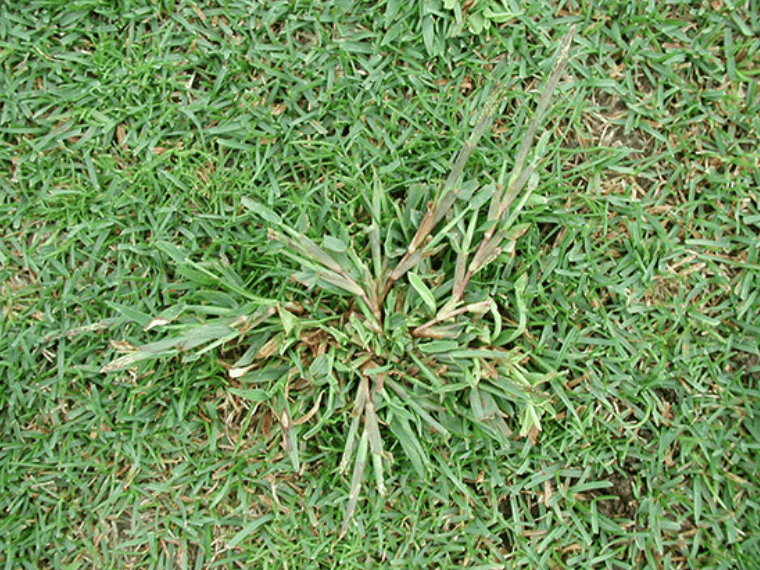
Crabgrass is a drought-tolerant annual weed that often emerges in early summer, and it thrives during the hot weather. It remains active in the lawn throughout the year until frost sets in. As the name suggests, the grass has creeping stems which root freely at the nodes to make it look like a crab.
At a first glance, crabgrass will appear like your other lawn grass. The invasive habit of crabgrass makes it a pest in lawns and cultivated fields. To control, you need to understand when crabgrass germinates and dies, and its key features.
To identify crabgrass accurately, look for its distinctive seed heads. The seed heads resemble crab legs or fingers, which is how the weed gets its name. These seed heads develop in late summer or early fall and can produce thousands of seeds, ensuring the weed’s persistence for the next year.
Crabgrass Identification – What it Looks Like
Crabgrass is an annual grass weed that shows up on lawns between the spring and late summer. Your property could be vulnerable to crabgrass if you mow the lawn too short or let bare turf areas develop. This weed usually has flat, wide leaf blades and grows tall clusters of flowers. This weed can spread quickly because of its ability to produce lots of seeds each season. You might recognize crabgrass on your property by its pointed, narrow leaves and short, purplish-green stems.
Although features may vary depending on the type of crabgrass, this is how to identify crabgrass in your lawn:
Texture
After germinating, crabgrass seedling will look like a miniature corn stalk. The plant appears lighter green in color which may eventually change to dark green as it continues to establish itself. Depending on the lawn conditions, mature crabgrass can have smooth or hairy blades.
Shape
As crabgrass grows, the leaves will start to branch out. When spreading out, crabgrass will form long branches that shoot out from the stem and turn in sharp angles, making the weed look like crab legs. At maturity, crabgrass continues to put up new shoots from the center, as the very first shoots also keep branching out to the side.
This growth pattern continues until the weed forms dense thick foliage. In a competitive environment where there are other plants, crabgrass will also grow straight upright before the branches begin to fall on the ground as they spread.
Color
Crabgrass has no specific color, it can range from light green to a deep dark green. Sometimes you may not easily identify this weed in your lawn. It is unfortunate that this weed thrives in hardy conditions where common lawn grass may not. That’s why it easily takes over a lawn during drought conditions.
Under proper sunlight and water conditions, crabgrass will blend well with the rest of the lawn grasses and you may notice it at maturity or when in large clamps. Due to its low height, low mowing may not affect it unless you set the blade to the lower setting which may also harm your grass.
Lifecycle
Crabgrass dies in the fall as soon as it is hit by frost. As it dies, it leaves behind thousands of seeds that will germinate in the spring through late summer when the soil temperature is above 55°F. Without preventive control, this cycle continues until crabgrass takes over your lawn, pavers, or yards.
Common Types of Crabgrass
The following are common types of crabgrass:
1. Smooth Crabgrass
Even though it doesn’t have as much hair as hairy crabgrass, smooth crabgrass has hairs at the small, ear-like projections inside the leaves’ base. Its stem is slender and also has a reclining growth pattern. The weed’s flowering system has a panicle of spread-out branches, but its small spikes look similar to hairy crabgrass.
2. Hairy crabgrass
This is the type of crabgrass that has long, straight hairs all over its leaves and stems. Its leaves are broader than smooth crabgrass, and it grows taller. This type of crabgrass has a stout stem and a reclining growth pattern. Its flowering system has a panicle of branches with small spikes.
3. Asian Crabgrass
Also known as tropical crabgrass, Asian crabgrass is native to Asia and Australia and commonly found in the Southern United States. Unlike the other crabgrass types, this one has seed head branches that stem from the same place on flower stems.
4. Southern Crabgrass
Southern crabgrass is native to America, Asia, and Africa. It has long wide leaves with long hairs on the leaf sheath.
Other less common types of crabgrass include Blanket crabgrass, Indian crabgrass, and Texas crabgrass. There are also crabgrass lookalikes which include Dallisgrass, Tall fescue, Johnsongrass, and Quackgrass among others.
Why Crabgrass is Not Welcome
Mature crabgrass is very much noticeable in a lawn. It is easy to spot this coarse-textured yellowish-green grass in your fine-textured grass. Once established, this weed is difficult to control, and unfortunately, it will keep on choking out your desired grass.
Mowing a lawn short is one of the effective ways of controlling weeds but that does not usually apply to crabgrass. Ironically, crabgrass can set seed heads when cut as low as 1/2 inch tall— that’s far lower than recommended healthy mowing heights for most common turf lawns.
Crabgrass cannot be controlled in one growing season due to a high number of viable seeds that will keep germinating in future years. This means you will need to be tactical and more patient to completely eliminate crabgrass from your lawn.
The physical structure of crabgrass is also known for creating perfect hiding and breeding spaces for pests. This doubles the problem of dealing with both weeds and other pests in your lawn.
Final Thought
Crabgrass is an annual weed that thrives throughout until it is killed by frost. Once allowed alongside the grass, crabgrass may overtake the whole lawn by the time you realize it. To effectively control crabgrass in your lawn, you have to identify it and decide whether you will remove it manually or use a chemical herbicide. Since crabgrass returns year after year through newly germinated seeds, maintaining a thick and healthy lawn, mowing correctly, and taking early preventive action are essential for keeping it under control. Whether you choose manual removal or herbicide treatment, consistency and patience are key to successfully eliminating crabgrass and restoring the beauty of your lawn.