A beautifully manicured lawn can be the pride of any homeowner and the envy of all the neighbors, but it’s not something that just happens – it takes time and effort to achieve the desired effect.
Most people know about watering a lawn, mowing it, fertilizing it and trimming the edges, but not everyone is quite so familiar with the practice of aeration. What is aeration? What are the benefits of aeration? How do I do it and how often should I aerate my lawn? Here we look at these questions and more related to this important aspect of lawn care.
What is aeration?
Let’s start with the basics – what is aeration? Well, at its most simple level, aeration is puncturing holes into the lawn to help it breathe.
Healthy soil should actually be made up of about 50% empty space, which is filled with air or allows water to penetrate beneath the surface.
However, with time, the soil beneath your lawn gradually becomes compacted, and aeration is a way to help it return to a healthier state.
Why should you aerate your lawn?
There are several reasons why aerating is vital for your lawn. Here are a few of the most important.
· It allows roots to grow deep and strong
Grass roots don’t grow in soil, they push into the gaps between it – and if there are no gaps, roots struggle. By aerating your lawn, you provide gaps for the roots to grow into, allowing your lawn to grow stronger and healthier.
· It helps water and nutrients penetrate deeper
If soil becomes too compacted, water and nutrients can’t penetrate below the surface. Remember, your grass drinks and feeds through its roots, and if water and nutrients are not available, it will starve.
· It prevents surface runoff
If the soil becomes heavily compacted, any water that falls on it will not only not penetrate below the surface but will also wash away the topsoil, carrying away any vital nutrients with it.
By ensuring your lawn is aerated, you will ensure your soil is not losing nutrients every time it rains.
How often should you aerate your lawn?
When it comes to aeration, how often you perform the service can be dependent on your soil type.
Once a year or even twice a year are usually adequate for clay soils, depending on how compacted they are. Sandier or loam soils may not need to be aerated as much, due to porous nature which allows for better oxygen flow to the roots.
How do you aerate your lawn?
If you’re convinced that aerating is a good idea, you might be wondering how it’s done. Well, the good news it’s very easy and there are a couple of techniques you can use.
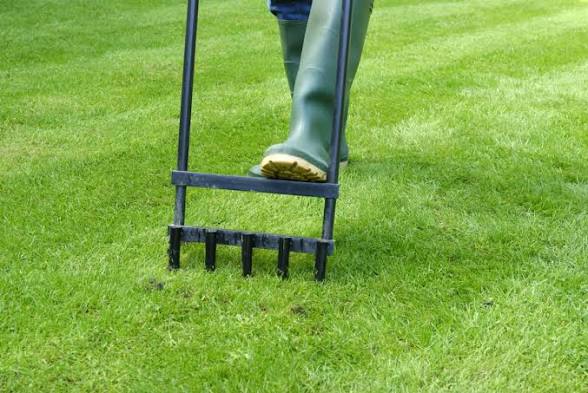
The simplest way, and one that doesn’t require any special equipment you don’t already have, is to take a regular garden fork and walk up and down in lines poking holes in the lawn every four inches or so.
To make sure you get good coverage, you can repeat the process in the other direction.
This is a good technique if your lawn is not too big, but it is also quite labor-intensive. Another way to do it, and something that still doesn’t cost a lot, is to buy a pair of special aeration sandals.
These are special shoes with spikes on the bottom – and all you need to do is walk up and down on your lawn to aerate it.
Alternatively, for larger lawns, you might prefer to buy or rent an aerating machine to do the job.
You also need to choose between a spike aerator and a plug aerator. Spike versions simply make holes in the ground whereas plug aerators remove plugs of soil. Plug versions are perhaps better in clay soils while spikes are probably more suitable in sandy soils.
When should you aerate?
Another important question is when you should aerate your lawn, and this depends on the type of grass you have. If you have cool weather grass, the growing season is in spring or fall, so you should aerate in early fall.
Hot weather grass grows most during the months of summer, so you should aerate in late spring.
Try to aerate when the ground is moist but not waterlogged. Depending on the climate where you live, avoid aerating in mid-winter or mid-summer – the ground at those times can be too hard or too dry for it to have any beneficial effect.
Aeration & Overseeding Mistakes to Avoid
When done correctly, aeration and overseeding can greatly benefit your lawn.
Avoid common mistakes which will cost valuable time and money, along with not gaining maximum benefit from work done.
Avoid these typical errors people tend to make when aerating and overseeding:
- Using the wrong equipment. Spiked shoes don’t do the same thing as an aerator and can further compact your soil. A core or plug aerator is the tool professionals prefer for proper aeration that removes 2- to 3-inch soil plugs at half-inch diameter, approximately 2 to 3 inches apart. Using the wrong equipment or using equipment incorrectly can also damage your turf, so be mindful of proper operation by following instructions carefully.
- Neglecting ideal timing. Respect the best time to aerate and overseed your lawn. One instance would beaerating and overseeding during dry periods. You will not be able to water sufficiently for maximum seed germination.
- Lack of proper watering. Once you’re done aerating and overseeding, you want to water your lawn and keep it evenly moist
- Lack of proper mowing. When seedlings first germinate, they are very tender, wait until seedlings are tall enough to mow. Make sure that your mower blade is sharp prior to mowing new seedlings.
- Simultaneously trying to fight weeds while aerating and overseeding. When you’re growing turfgrass, you’re trying to build an ideal environment for seeds to germinate and establish. Weeds will get in the way of this process, but you should wait until after seed germination and after you’ve mowed about two to three times (approximately 4 to 6 weeks) before you can use any herbicide to try and control weeds.