The only way to have a healthy, vigorous lawn in front of your home is to fertilize it correctly. There is a lot of literature on the subject, but all these articles will be useless if you don’t know the details of the soil type and the grass you grow. The most crucial ingredient your lawn needs is nitrogen, but other important nutrients, such as potassium or phosphate, may also be needed to enrich the soil.
The type of lawn fertilizer you should apply depends on your grass and soil. Keep in mind that the fertilizer you choose will affect both your lawn’s appearance and the maintenance it requires. One more thing! You don’t need to be upset about fertilizing. It is not a big deal. It takes about 15 to 20 minutes, an excellent fertilizer, and a fertilizer spreader, and the results will be fantastic!
Why Fertilize?
Along with water, your lawn will need nutrients to survive. Good soil will generally supply your grass with most of the necessary nutrition, but many poor soils can’t provide everything your lawn needs during the growing season.
Therefore, you should help grass become green, lush, thick, and healthy by feeding it up to four times a year. At the same time, a lush lawn helps prevent weed seeds from sprouting.
Types of Nutrients Your Lawn Needs
1). Primary Nutrients are not easily available in the soil. They should be added using fertilizers.
- Nitrogen– This mineral is essential for plant growth and the development of vivid, green leaves
- Phosphorus– It is responsible for root growth and the production of flowers, fruit, and seeds.
- Potassium– Without it, there will be problems with root development, and grass couldn’t develop resistance to various diseases and drought.
2). Secondary Nutrients (oxygen, magnesium, calcium, carbon, sulfur, and hydrogen are often widespread in soil or air, and it is usually not necessary to add them.
3). Micronutrients (chlorine, iron, copper, boron, cobalt, zinc, nickel, molybdenum, and manganese) are nutrients your grass will need in just a small amount.
Fertilizer will help:
- Help roots and leaves grow properly.
- Recovering the lawn from pests
- Reducing weeds
- Replacing nutrients after volatilization and leaching
Undoubtedly, spring is the best season to fertilize your lawn. In April, soil temperatures are approximately 55°F (13°C), which is an ideal time for grass to start growing. November 15th is the proper time for the last lawn fertilizer application.
Preparing Your Lawn for Fertilizing
There are some essential steps you should follow before you begin to fertilize your lawn.
1. Test the soil
To test your lawn’s soil, you need some samples. Dig approximately ten individual holes about 3 to 4 inches (7.5 to 10 cm) deep and randomly collect soil samples. Avoid picking up soil with roots or other vegetation. Mix all samples and put one cup in a plastic bag.
Now, send the sample to the competent institution (local university, county extension office, or even garden center) for testing. The most important information you will get is:
- How much of each main nutrient (potassium, sulfur, gypsum, phosphorus, and lime) your soil contains.
- The pH of your soil (6.5 to 7.0 is best for grass). If the result is lower than 6.0, you will need to ‘sweeten’ the soil by adding lime. If the result is above 7.5, you need to add sulfur to fertilizer.
Depending on the results, you can determine the best fertilizer for your lawn and the appropriate time to apply it.
If test results show you need to correct pH or nutrient levels, consider testing your lawn’s soil annually until you solve the problem. Conversely, if the results are good, there is no need to repeat the test more than once every three years.
Useful tips:
- Try to do testing in early spring, before grass starts growing.
- Keep in mind that it is useless to collect samples after fertilizing your lawn.
- Avoid do-it-yourself kits. They are cheap, but not accurate enough.
2. Soil aeration
In case you need to aerate your lawn, do it along with fertilizing. It is a useful procedure that creates small holes in the soil, allowing fertilizer, water, and air direct access to the grass roots.
One of the best ways of aeration is using a core aerator. This machine will pull plugs of soil from your lawn. You may want to check your riding mower. Some of them have attachments for a core aerator. If not, rent one. If your lawn is small, you can use a digging fork. Plunging it about 0.5 inches (1.3 cm) into the soil will bring enough air to the roots of your grass.
3. Determine your lawn size
You will find the user guide on every fertilizer package you buy. Read carefully about how much fertilizer you need to cover your lawn, depending on its size and soil type.
Multiply the length and width of your lawn to calculate the square footage of your yard. Since you don’t need to fertilize the surface area of your house and driveway, subtract those areas.
4. Determine grass type on your lawn
It is essential to define the suitable type of grass that grows on your lawn. That is the most accurate way to calculate the right amount of nitrogen you need to apply. Since average grasses, such as centipede and blue grama grasses, need two pounds of this nutrient per year for every 1,000 square feet (93m2) of lawn, you can quickly estimate how much fertilizer you need during this period.
The same is true for other types of grass. A calculation is simple if you know that:
- Fine fescue, ryegrass, St. Augustine, zoysia, or Bahia grasses need 2 to 4 pounds per 1,000 square feet of lawn per year.
- Tall fescue, Kentucky bluegrass, bentgrass, or Bermuda grasses require 3 to 6 pounds per 1,000 square feet of lawn per year.
It helps to know that bags you can buy usually cover 5,000 to 15,000 square feet (465 to 1400 m2). Basically, the variety of grass is not crucial, but the type is. The grass in your lawn can be:
- Warm-season type (grows in southern states)
- Cool-season type (grows in northern states)
Don’t forget that a third of states in the US have a transitional climate. That means both types of grasses can grow in those regions. To be sure, you can check the regional grass map of the US.
Cool-season grasses
If you live in a cold or transitional area with temperatures between 60 and 75°F (15.5 to 24°C) and grow cool-season grasses on your lawn, you already know they stay green almost year-round.
This grass type requires moderately warm summers and cold winters. The most common cool-season grasses in the US are:
- Kentucky bluegrass
- Bentgrass
- Ryegrass (both annual and perennial)
- Blue grama
- Fine and tall fescue
Warm-season grasses
If you live in regions with temperatures of 80 to 95 F (27 to 35 C), you should grow warm-season grasses. Most require dry, hot summers and turn brown during three to five winter months when temperatures are below 60°F (15.5°C). The most common are:
- Zoysia
- Bahia
- Bermuda
- Augustine
- Centipede
- Buffalo
5. Proper materials for lawn maintenance
- An excellent lawn fertilizer
- A spreader
- A sprinkler
- Enough water
When to fertilize lawn?
To get a healthy, green lawn, use high-quality fertilizer and apply it on time. Which option is best for you will depend on your region’s climate and the grass type on your lawn.
- Cool-season grasses
The best time to fertilize this type of grass is in early fall. Many experts in this field believe you need only one fertilizer application a year if you use so-called ‘winterizer fertilizer.’ The best period is in the fall (October or November). If you want to apply fertilizer one more time during a year, do it in early spring before the summer heat.
- Warm-season grasses
An ideal period for fertilizing this type of lawn depends on the variety of grasses you have. Fertilize your lawn before the grass reaches its maximum growing phase. In southern areas, try to do it in late spring or early summer.
The second application should be in late summer, but not after September 1. You have two options: quick-release or slow-release fertilizer, because both are acceptable for this grass type.
Types of fertilizers
At first, selecting the right fertilizer product for your lawn will probably be overwhelming. Over time, you will discover which fertilizer suits your lawn best, and everything will become much more comfortable.
1. Granular
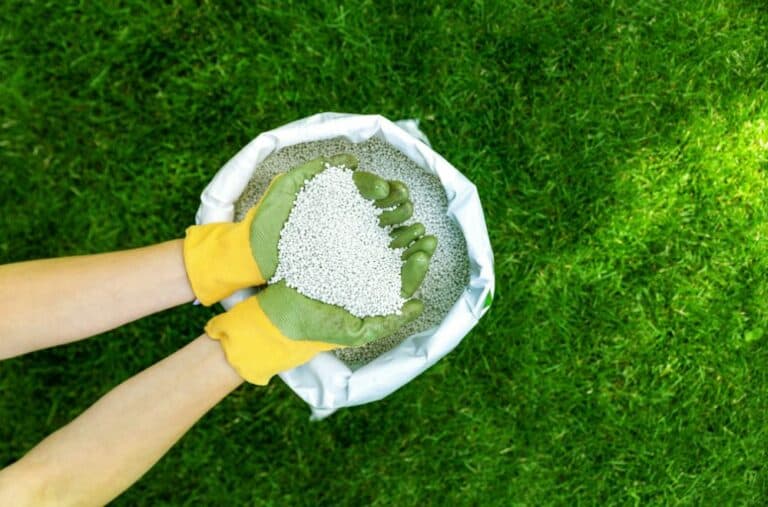
Fertilizers for lawns are usually in granular form because it is easier to control how much you use and to see how it disperses. You can choose:
Quick-release fertilizers (water-soluble nitrogen) – They provide nitrogen to grass right away and last for about a month.
Slow-release fertilizers (water-insoluble nitrogen) – There are two types of them:
-
- A sulfur-coated variety (their effects last for about two months)
- A polymer-coated variety (their effects last for about three months)
2. Liquid
Liquid fertilizers act faster because their absorption through the leaves or roots is almost immediate. Therefore, you should apply them twice a month.
3. Plant food spikes
It is a substantial form of fertilizer. They provide simple plant feeding by releasing nutrients through the soil over time.
4. Grass-cycling
Grass-cycling is a way to maintain the lawn by letting grass clippings on the lawn after cutting. The positive sides of this technique are:
- You don’t need to bag grass after mowing.
- Your lawn will stay greener throughout the year.
- It will make fertilizing easier.
- After decaying, clipped grass will provide 25% of the beneficial nutrients your lawn needs.
- 100 pounds (45 kg) of grass clippings yield about 3 to 4 pounds (1.4 to 1.8 kg) of required nitrogen
- It is a pocket-friendly solution.
5. Compost as fertilizer
Despite some shortcomings, compost is almost an ideal solution if you prefer organic lawn care practices and can find it. It contains all the necessary organic matter, micronutrients, and beneficial microorganisms to feed both grass and soil.
The best part is that compost provides enough nitrogen that will slowly become available to grass roots. That way, there will be no heavy nitrogen leaching over time.
Apply it before grass over-seeding. Once your lawn is established, spread compost over the lawn in a thin layer to encourage strong grass growth in early spring.
6. Clovers
If you are a ‘green type of person’, it may be a good idea to add clover to your lawn. This plant is a natural nitrogen source and can enrich the soil by converting nitrogen from the air into a form available to grass roots. It is resistant to most lawn pests and diseases and drought-tolerant. Plus, clovers don’t require frequent mowing because they grow slowly.
Tips for fertilizing your lawn
As I’ve said, every lawn has specific fertilizer requirements. The best you can do, especially if you are a novice, is to read the instructions on the bag carefully. You don’t want to calculate the formula wrong.
There are three formulations you can use:
a). Weed and feed – It is a lawn fertilizer with weed killer. Check the label before using it to see if it is a good match for your lawn, which depends on the weeds you spotted. They can be:
-
- Pre-emergents – Apply them in early spring, before weeds start germinating.
- Post-emergents– Apply them after weeds start growing actively.
b). Winterizers – These potassium-rich fertilizers will help cool-season lawns cope with stress during winter more easily.
c). Starter fertilizers – These phosphorus-rich fertilizers will help your new lawn develop healthy, strong roots.
Summary Note
In the end, don’t forget to water your lawn thoroughly a few days before you decide to feed it. That way, you will help the soil accept fertilizer readily. However, the critical watering is the one after the grass dries and after applying fertilizer. Light watering will wash fertilizer off the grass into the soil.
Keep in mind that excessive watering will rinse the ground and help the grass grow lusher. Consequently, you will need to fertilize your lawn more often.